

In today’s fast-paced digital world, maximizing productivity is essential. One effective way to achieve this is by setting up dual monitors. This setup not only enhances multitasking capabilities but also provides a more immersive experience for work or entertainment.
Imagine having the ability to spread out your applications across two screens, allowing for seamless transitions between tasks. Whether you’re a professional working from home or a gamer seeking an edge, dual monitors can transform your workspace into a powerhouse of efficiency. With the right setup, you can unlock your full potential and elevate your daily routine.
Benefits Of Dual Monitors
Dual monitor setups offer significant advantages in productivity and multitasking for users. These benefits cater to various professional needs and enhance overall workflow efficiency.
Increased Productivity
Increased productivity stems from the ability to display multiple applications simultaneously. Users can keep essential tools, such as email and calendars, open on one screen while working on documents or tasks on another. Studies indicate that individuals using dual monitors experience a productivity boost of up to 20-30% (source: IDC). This arrangement reduces the time spent switching between tabs and windows, allowing for quicker access to necessary information.
Enhanced Multitasking
Enhanced multitasking capabilities come from the extended screen real estate provided by dual monitors. Users can easily compare documents or data side by side, leading to faster decision-making. For instance, a financial analyst can display spreadsheets on one monitor while analyzing metrics on another. This dual display setup also benefits creative professionals, enabling them to work on design projects while referencing inspiration or client briefs. Research shows that multitasking is more efficient with dual monitors, as individuals can maintain focus on several tasks without losing momentum.
Preparing Your Workspace
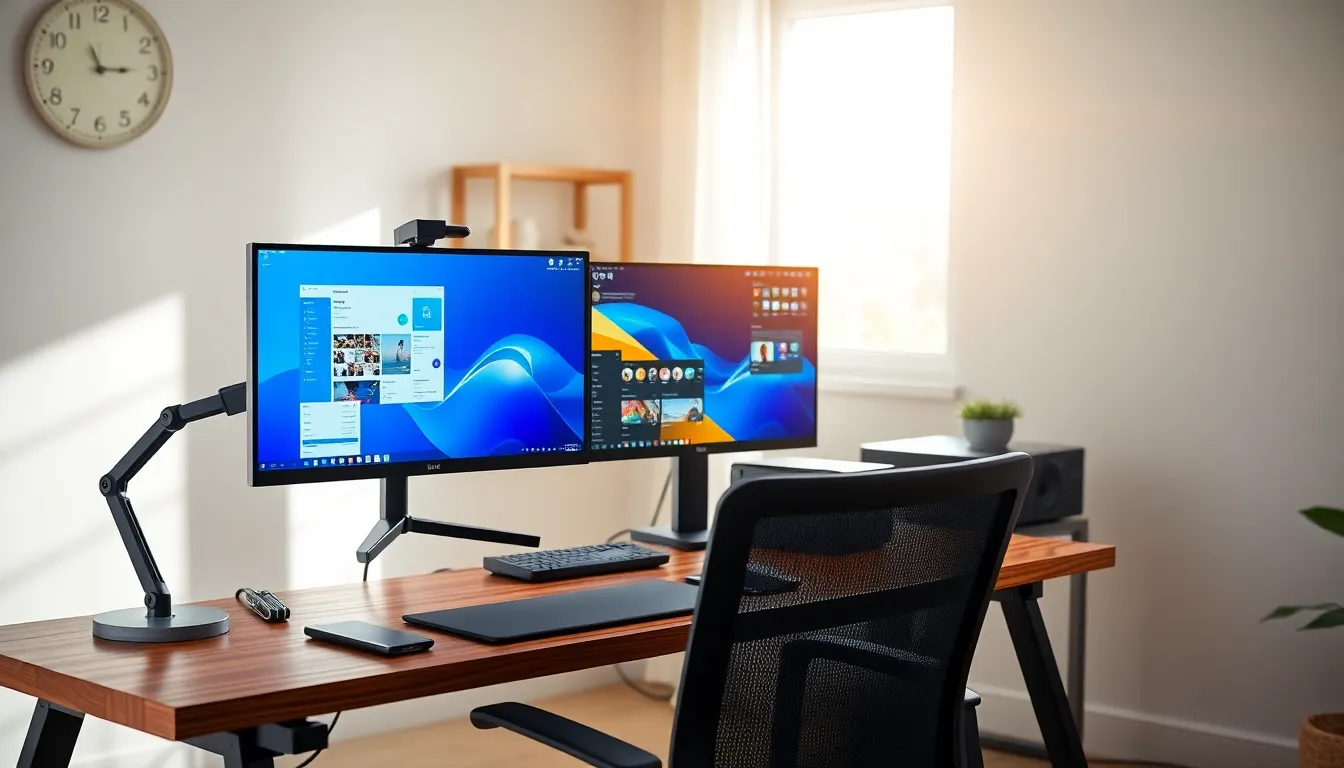
Setting up dual monitors requires careful preparation of the workspace to ensure optimal functionality and comfort. Proper planning facilitates a seamless integration of the monitors into the existing environment.
Choosing The Right Monitors
Select monitors that align with specific needs and preferences. Consider screen size; options typically range from 21 to 32 inches, with larger screens offering more workspace. Review resolution; Full HD (1920×1080) works for basic tasks, while 4K (3840×2160) suits graphics-intensive applications. Evaluate panel types; IPS panels provide superior color accuracy, while TN panels often have faster response times. Check connectivity options; ensure compatibility with available ports like HDMI, DisplayPort, and USB-C for efficient setup. Assess the ergonomic features; adjustable stands, tilt, and swivel options enhance user comfort and accommodate various seating arrangements.
Measuring Your Desk Space
Measure the desk dimensions to determine the available space for dual monitors. Ensure sufficient depth, as monitors typically require at least 6 to 10 inches from the back of the desk to provide comfortable viewing distances. Confirm the width accommodates two monitors side by side; ideally, a space of 48 inches or more is preferable for a comfortable arrangement. Assess height positioning; both monitors should align at eye level to minimize neck strain. Check for cable management options; keeping cables organized enhances aesthetics and prevents clutter.
Steps To Setup Dual Monitors
Setting up dual monitors involves several straightforward steps. This process allows users to maximize their workspace and enhance productivity effectively.
Connecting The Monitors
- Select connection types. Identify suitable connection ports on both monitors, such as HDMI, DisplayPort, or VGA. Ensure the computer’s graphics card supports these connections.
- Connect cables. Plug one end of each cable into the ports on the monitors and the other end into the respective ports on the computer. Double-check that connections are secure.
- Power on the monitors. Switch on both monitors and the computer. The system typically detects the monitors automatically. If not, additional steps may be necessary.
Adjusting Display Settings
- Access display settings. Right-click on the desktop and select “Display settings” to open the settings menu. This menu displays connected monitors.
- Arrange displays. Drag and position the monitor icons to reflect their physical arrangement. Ensuring the layout matches reality aids in seamless navigation between screens.
- Select the primary display. Choose one monitor as the primary display for the taskbar and app shortcuts. Click on the preferred monitor icon and enable “Make this my main display.”
- Adjust resolution. Set an appropriate resolution for each monitor, ensuring clarity and visibility for all content. Experiment with different settings for optimal results.
- Customize scaling. Adjust the scaling settings to enhance readability and usability. This setting ensures icons and text are appropriately sized on both monitors.
Common Issues And Troubleshooting
Setting up dual monitors can present some challenges. Identifying common problems and troubleshooting them effectively enhances the user experience and ensures optimal performance.
Connection Problems
Connection problems often arise due to incompatible cables or ports. Users should confirm compatibility with the graphics card and monitor output. Checking the cable connections is essential; loose or damaged cables can disrupt the signal. Users can also test different ports on the computer to determine if one may be malfunctioning. If monitors remain unresponsive, rebooting the computer may help reset the connection. Updating graphics drivers through the manufacturer’s website frequently resolves many connectivity issues as well.
Display Issues
Display issues can include resolution mismatches and incorrect scaling. If the monitors display the same image instead of extending the desktop, users should access the display settings and select “Extend these displays.” Adjusting resolution settings for each monitor to match the native resolution can enhance clarity. Users experiencing color discrepancies should consider calibrating their monitors via system settings or third-party calibration tools. Flickering images or inconsistent refresh rates may relate to outdated drivers, so updating those is advisable. If the issue persists, testing with different cables can help identify defective equipment.
Embracing a dual monitor setup can transform the way individuals work and play. By enhancing productivity and multitasking capabilities, this configuration allows users to navigate their tasks with ease and efficiency. Whether for professional use or gaming, the benefits are clear.
With thoughtful preparation and the right equipment, anyone can create a workspace that promotes focus and comfort. The potential for increased productivity is significant, making dual monitors a worthwhile investment for those looking to elevate their daily routines. Adopting this setup can lead to a more organized and effective workflow, ultimately paving the way for greater success in various endeavors.


